Anyone working on in‑building DAS probably has a handful of N‑type loads in their toolkit. Screw them on for field testing, port termination, or troubleshooting. But things have changed over the last few years – antenna panels are getting denser, and N‑type connectors are simply too bulky. NEX10 is showing up on more and more equipment.
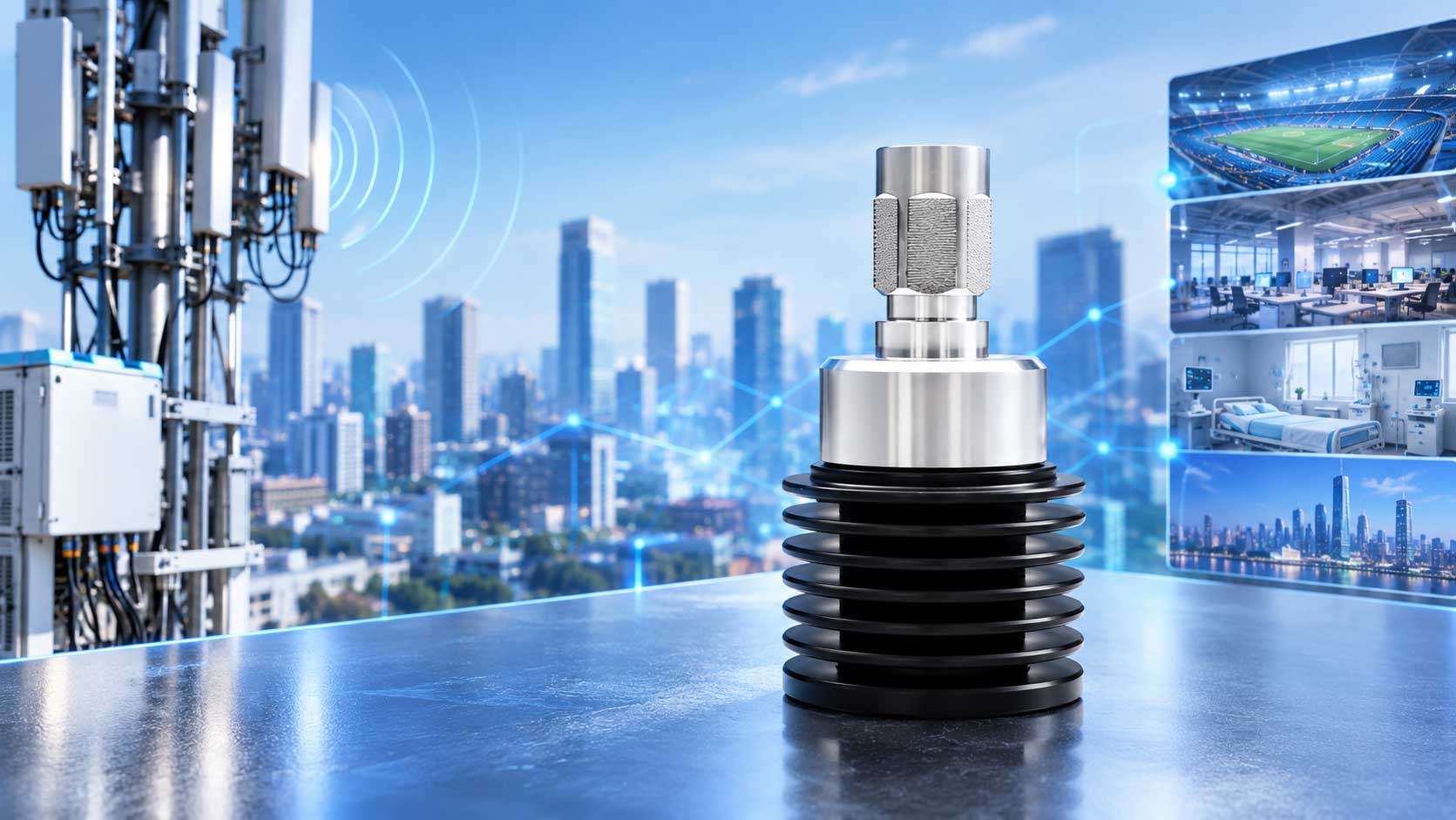
Maniron's MNDL‑20‑6‑Nex10M – DC‑6GHz, 20W, NEX10 male, VSWR ≤1.25. The datasheet looks plain, but in today's DAS engineering context, its real value isn't on the spec sheet – it's in the on‑site problems that nobody talks about.
Definition: What Is an RF Load?
An RF load (RF Load), also called a dummy load or termination, is a passive device used to absorb RF energy and convert it into heat.
Core definition of an RF load:
It provides a precise 50Ω impedance match at the end of a transmission line, ensuring that signals go only one way – into the load. An ideal RF load is a pure resistor whose value matches the impedance of the antenna or transmission line (typically 50Ω or 75Ω). An ideal dummy load should provide a 1:1 VSWR.
Think of it as an "antenna that never radiates." When an antenna cannot be connected or radiation is not needed, the RF load takes its place, absorbing all RF power from the transmitter. If this load is missing or faulty, an unterminated port creates full reflection – reflected power can destroy the power amplifier, raise the VSWR, and destabilise the entire system.
In DAS / IBS (in‑building solutions) commissioning, maintenance, and troubleshooting, the RF load is an indispensable tool.
What Is NEX10?
NEX10 is a compact, low‑PIM RF coaxial connector system developed jointly by several major RF manufacturers to meet the space‑saving requirements of small cells and 5G networks. The flange height of NEX10 is only 12.7mm, which is about 50% smaller than the traditional 4.3‑10 connector.
Key technical characteristics of NEX10:
|
Parameter
|
Specification
|
|
Impedance
|
50Ω
|
|
Frequency Range
|
DC – 20GHz
|
|
PIM (Passive Intermodulation)
|
Better than -166dBc
|
|
Return Loss (below 6GHz)
|
≥36dB
|
|
Typical Power Rating
|
100W @ 2GHz @ 85°C
|
|
Waterproof Rating
|
IP68
|
|
Coupling Mechanism
|
Quick‑lock and threaded
|
The most critical design feature of NEX10 is the separation of electrical contact from mechanical contact. Traditional connector PIM performance depends on torque – tighten more or less and PIM changes. NEX10's design makes PIM stability independent of torque. In mass production of small cells and DAS equipment, this directly determines product consistency.
MNDL‑20‑6‑Nex10M: Full Technical Specifications
Maniron's MNDL‑20‑6‑Nex10M is a DC‑6GHz, 20W RF load with an NEX10 male connector. Full specifications:
|
Parameter
|
Specification
|
Comment
|
|
Model
|
MNDL‑20‑6‑Nex10M
|
Maniron part number
|
|
Frequency Range
|
DC – 6GHz
|
Covers all 2G/3G/4G/5G Sub‑6GHz bands
|
|
VSWR
|
≤ 1.25
|
Reflected power less than 1.2%
|
|
Impedance
|
50Ω
|
Standard RF system impedance
|
|
Average Power
|
20W
|
CW power capacity
|
|
Connector Type
|
NEX10 Male
|
Mates with NEX10 female ports
|
|
Operating Temperature
|
‑25°C ~ +65°C
|
Indoor and outdoor cabinet environments
|
|
Colour
|
Black
|
|
|
Origin
|
China
|
Maniron Hefei factory
|
Parameter Deep Dive – What Do These Numbers Mean?
VSWR ≤ 1.25 – What Does It Mean?
VSWR (Voltage Standing Wave Ratio) is the key metric for impedance match. The closer to 1.0, the better the match and the less reflection.
-
VSWR 1.25:1 corresponds to a return loss of about 19dB, meaning only about 1.2% of incident power is reflected.
-
98.8% of RF energy is safely absorbed and converted to heat.
-
This is excellent for a 20W load. Many competing loads at this power level have VSWR of 1.30‑1.45. Achieving ≤1.25 over DC‑6GHz indicates solid internal impedance matching and machining precision.
20W – Is It Enough?
20W average power places this load in the medium‑power category – precisely the range covering the most common field test scenarios:
-
Base station / repeater single‑carrier output testing: Most indoor coverage sources output between 5‑20W.
-
Power amplifier single‑stage debugging: For testing individual PA modules in a DAS, 20W is plenty.
-
Small‑signal link calibration: Low‑power verification of system link budgets.
If you need to test 100W or higher, Maniron also offers higher‑power loads (100W+). The 20W model is positioned precisely for the most commonly used power range for field engineers.
DC‑6GHz – What Does It Cover?
-
All 2G/3G/4G bands: 700‑2700MHz fully covered
-
5G Sub‑6GHz main bands: 3.5GHz (n78), 4.9GHz (n79)
-
Future‑proof: Spectrum below 6GHz continues to be released for new services
One load covering DC‑6GHz means one tool for all low‑to‑mid band test needs – no need for different loads per band, fewer items to carry, less risk of connecting the wrong one.
NEX10 vs N‑Type – Why the Change?
|
Aspect
|
N‑Type
|
NEX10
|
|
Size
|
Standard
|
Flange height 12.7mm, 50% smaller
|
|
Max Frequency
|
11GHz (precision 18GHz)
|
20GHz
|
|
PIM Stability
|
Torque‑dependent
|
‑166dBc, torque‑independent
|
|
Typical Application
|
Traditional base stations, test equipment
|
Small cells, MIMO, DAS
|
|
Port Density
|
Low
|
High – more ports in the same panel area
|
A Massive MIMO antenna panel can have dozens of RF ports. With N‑type or 4.3‑10, panel size becomes unmanageable. NEX10 makes high‑density antennas and small cells feasible. The Maniron load with NEX10 male can be plugged directly into an NEX10‑equipped antenna or device port for testing – no adapter needed.
Three Core Applications of RF Loads in DAS/IBS Systems
Scenario 1: Termination of Unused Ports
This is the most basic and most overlooked application.
In DAS systems, splitters, couplers, and combiners often have temporary unused ports. If these ports are left open – without a termination – they become open circuits, creating full reflection.
-
Reflected signals raise the VSWR of the entire chain.
-
Reflected power adds to the PA output, potentially damaging the power amplifier.
-
In multi‑carrier combining scenarios, a single open port can interfere with other channels.
Correct practice: All unused ports must be terminated with a 50Ω RF load.
Scenario 2: Transmitter Testing and Power Calibration
When installing or tuning a base station or repeater, you should never connect the antenna and start full‑power transmission immediately – if VSWR is abnormal, the PA can blow instantly.
Standard procedure:
-
Connect an RF load (e.g., MNDL‑20‑6‑Nex10M) to the transmitter output port.
-
Power on and measure output power with a power meter.
-
Once verified, replace the load with the actual antenna.
Using a load instead of an antenna for testing also avoids unwanted radiation – no interference with other nearby communication equipment.
Scenario 3: "Segmented Isolation" for Troubleshooting
When a DAS system reports a VSWR alarm or elevated uplink noise floor, you need to quickly identify whether the problem is in the antenna, feeder, or component.
The most effective field technique is segmented isolation:
-
Terminate the antenna end with a load – if VSWR returns to normal, the issue is upstream of the antenna, i.e., the antenna itself is faulty.
-
Move the load to the output port of a splitter, test stage by stage, working upstream to narrow the fault.
-
Terminate the combiner output to check if the combiner is functioning correctly.
Selection Guide – Four Key Parameters
1. Power Handling
This is the single most important parameter.
-
Average power: The continuous‑wave (CW) power the load can sustain long‑term. MNDL‑20‑6‑Nex10M is rated at 20W.
-
Selection rule: The load's power rating must exceed the maximum output power of the device under test – ideally with at least 50% margin. For example, a 20W load is reasonable for testing a 15W repeater; for a 20W repeater, a 50W load is safer.
2. Frequency Range
The load's frequency range must cover the signal bands you need to test.
-
MNDL‑20‑6‑Nex10M covers DC‑6GHz.
-
This fully covers all 2G/3G/4G/LTE bands (700‑2700MHz) and the main 5G Sub‑6GHz bands (3.5GHz, 4.9GHz, etc.).
-
For the vast majority of current indoor coverage projects, this range is more than sufficient.
3. VSWR
Lower VSWR means less reflection and more trustworthy test results.
-
MNDL‑20‑6‑Nex10M has VSWR ≤1.25, which is excellent.
-
Maintaining ≤1.25 across such a wide range (DC‑6GHz) indicates solid internal impedance matching.
4. Connector Type
The connector must match your equipment port.
-
This load uses NEX10 male.
-
If your device has N‑type female, they are not directly compatible – you need an NEX10 female to N‑type male adapter cable.
-
If your device already has NEX10 female, just screw it on directly.
FAQ
Q1: Are "RF load" and "dummy load" the same thing?
Yes. RF Load, Dummy Load, and Termination all refer to the same type of passive device used to absorb RF energy and provide impedance matching.
Q2: What does VSWR 1.25 on the MNDL‑20‑6‑Nex10M mean in practice?
It means only about 1.2% of incident power is reflected; 98.8% is absorbed. Maintaining this across DC‑6GHz is an excellent performance level.
Q3: What size of device can I test with a 20W load?
It is recommended for equipment up to 15W. The rule is that the load rating must exceed the maximum output power, preferably with 50% headroom.
Q4: Can NEX10 and N‑type connectors be directly interconnected?
No. NEX10 and N‑type are different connector standards with different physical dimensions and mating interfaces. An adapter cable or adapter is required.
Q5: Why is NEX10's PIM performance more stable than N‑type?
NEX10 uses a design that separates electrical contact from mechanical contact. Traditional connectors have PIM that varies with torque; NEX10's PIM stability is independent of torque.
Q6: What happens if I leave a port unterminated?
An open port creates a full reflection, which raises VSWR, can damage the power amplifier, and may interfere with other channels.
Q7: Does DC‑6GHz cover 5G?
Yes. The main 5G Sub‑6GHz bands (3.5GHz n78, 4.9GHz n79) are all within 6GHz.
Q8: Is ‑25°C to +65°C sufficient for most applications?
This covers the majority of indoor and outdoor cabinet environments. For extreme conditions (e.g., unheated outdoor cabinets in very cold climates), verify that the actual ambient temperature falls within this range.